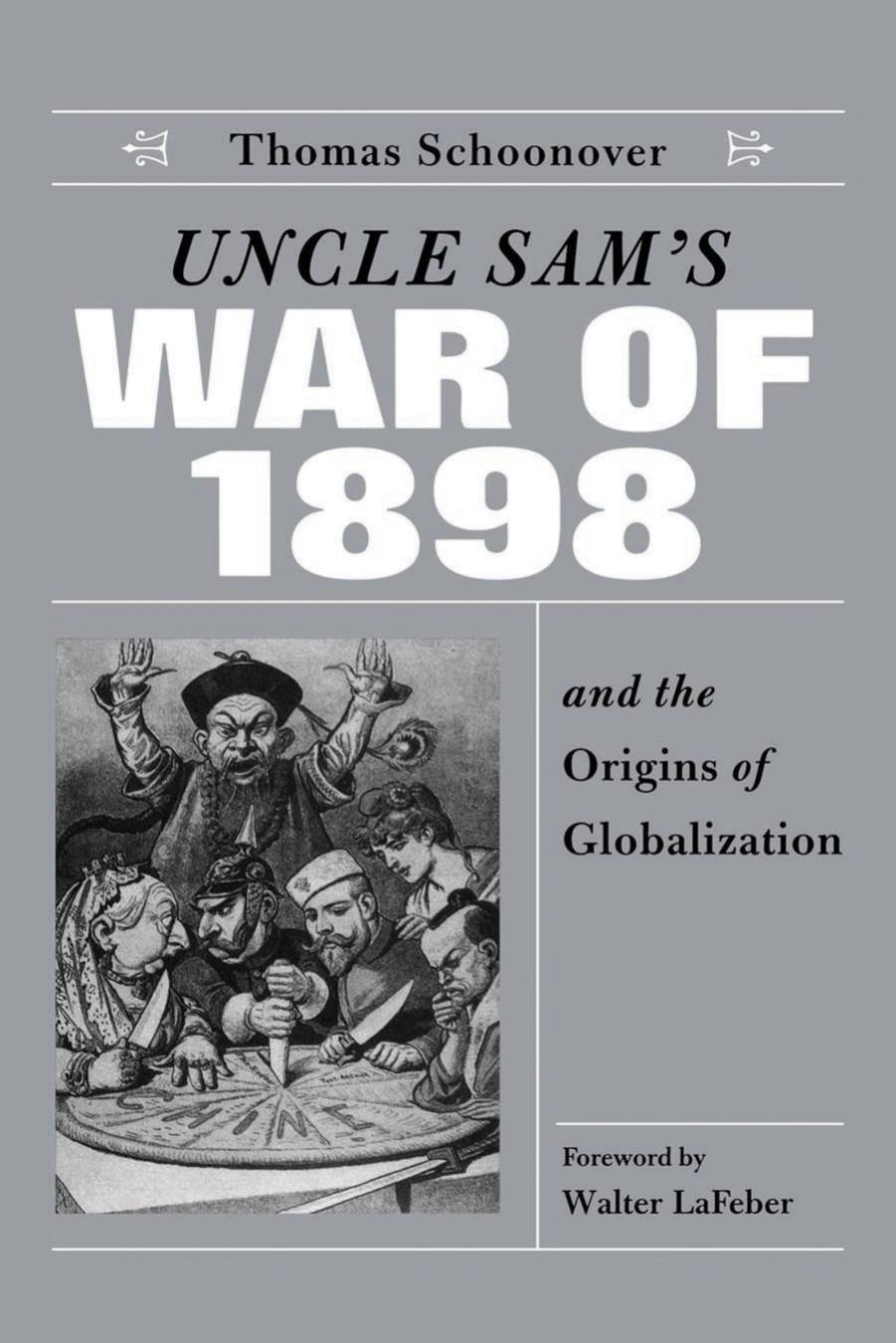
Uncle Sam's War of 1898 and the Origins of Globalization by Thomas D. Schoonover
Author:Thomas D. Schoonover [Schoonover, Thomas D.]
Language: eng
Format: epub, pdf
Tags: History, Military, United States, Wars & Conflicts (Other), General, Political Science, Globalization
ISBN: 9780813143361
Google: JpsRZqopiN4C
Publisher: University Press of Kentucky
Published: 2013-07-24T16:06:18+00:00
Dunne was also hard on the moralistic and humanistic arguments advanced to support U.S. expansion by war. He had Dooley comment: âTake up thâ white manâs burden anâ hand it to thâ coons.â Dooley noted the crass reality behind the alleged humanitarianism: âHands acrost thâ sea anâ into some wanâs pocket.â4
Some major political figures, including House Speaker Thomas Reed and Senator George Hoar, saw racism and anti-democratic conduct guiding U.S. relations with the Filipinos. After peace in the War of 1898, Hoar observed, the U.S. government and military âcrushed the Republic that the Philippine people had set up for themselves, deprived them of their independence, and established there, by American power, a Government in which the people have no part, against their will.â In fact, many Filipino municipalities had instituted self-government after the Spanish willingly or unwillingly departed.5
In the 1890s, U.S. society debated immigration restriction. Speaker Reed distrusted the 1898 version of U.S. idealism: âNow we are going to take in eight million barbarians and semi-barbarians, and we are paying twenty million dollars to get them.â6 Reacting to the U.S. payment for the Philippines, he remarked acidly, âWe have bought ten million Malays at $2.00 a head unpicked,â and added in a most prescient comment, ânobody knows what it will cost to pick them.â Picking them was dangerous and costly. On 4 February 1899 fighting broke out between Filipinos and U.S. troops.7 The fighting endured for decades.
Dunne and Dooley recognized the difference between a benefactor of civilization and a bandit. Dooley described the potential fates for Emilio Aguinaldo around 1899. Claiming that Aguinaldo mistakenly thought âthâ bom [boom] was still on in thâ hero business,â Dooley recognized that Aguinaldo sought to make âthâ Phâlippeens indepindint on us fâr support. ⦠If heâd [laid down his arms] come in, yeâd be hearinâ that James Haitch Aggynaldooâd been appointed foorth-class postmasther at Hootchey-Kootchey; but now thâ nex ye know iv him âll be on thâ blotther at thâ polis station.â8
Speaker Reed shared Dunneâs satirical humor over U.S. conduct in the Philippines. Aguinaldo was captured in March 1901. Reed, in mock surprise, asked his partner: âWhat, are you working today? I should think you would be celebrating. I see by the papers that the American Army has captured the infant son of Aguinaldo and at last accounts was in hot pursuit of the mother.â9 Then the conflict seemed to wind down.
The war was costly, and forces on both sides committed atrocities; the inhumanity reflected the intensity. By the summer of 1901, things seemed nearly over in the northern islands. But at Balangiga on Samar Island, a U.S. detachment was overrun and seventy-four U.S. soldiers killed. Major General Adna R. Chaffee determined to end the conflict in the northern islands. He sent one brigade to southern Luzon and a second to Samar Island.10
At Balangiga, most U.S. soldiers had died in the fort or trying to cross the bay to Leyte. U.S. troops in Leyte quickly crossed the bay to find a ghastly sight of dead and mutilated U.
Download
Uncle Sam's War of 1898 and the Origins of Globalization by Thomas D. Schoonover.pdf
This site does not store any files on its server. We only index and link to content provided by other sites. Please contact the content providers to delete copyright contents if any and email us, we'll remove relevant links or contents immediately.
The Secret History by Donna Tartt(19092)
The Social Justice Warrior Handbook by Lisa De Pasquale(12191)
Thirteen Reasons Why by Jay Asher(8912)
This Is How You Lose Her by Junot Diaz(6889)
Weapons of Math Destruction by Cathy O'Neil(6281)
Zero to One by Peter Thiel(5802)
Beartown by Fredrik Backman(5759)
The Myth of the Strong Leader by Archie Brown(5509)
The Fire Next Time by James Baldwin(5448)
How Democracies Die by Steven Levitsky & Daniel Ziblatt(5219)
Promise Me, Dad by Joe Biden(5154)
Stone's Rules by Roger Stone(5088)
A Higher Loyalty: Truth, Lies, and Leadership by James Comey(4964)
100 Deadly Skills by Clint Emerson(4927)
Rise and Kill First by Ronen Bergman(4790)
Secrecy World by Jake Bernstein(4753)
The David Icke Guide to the Global Conspiracy (and how to end it) by David Icke(4720)
The Farm by Tom Rob Smith(4514)
The Doomsday Machine by Daniel Ellsberg(4490)
